

Chef Osvaldo
The effort was all in the preparation

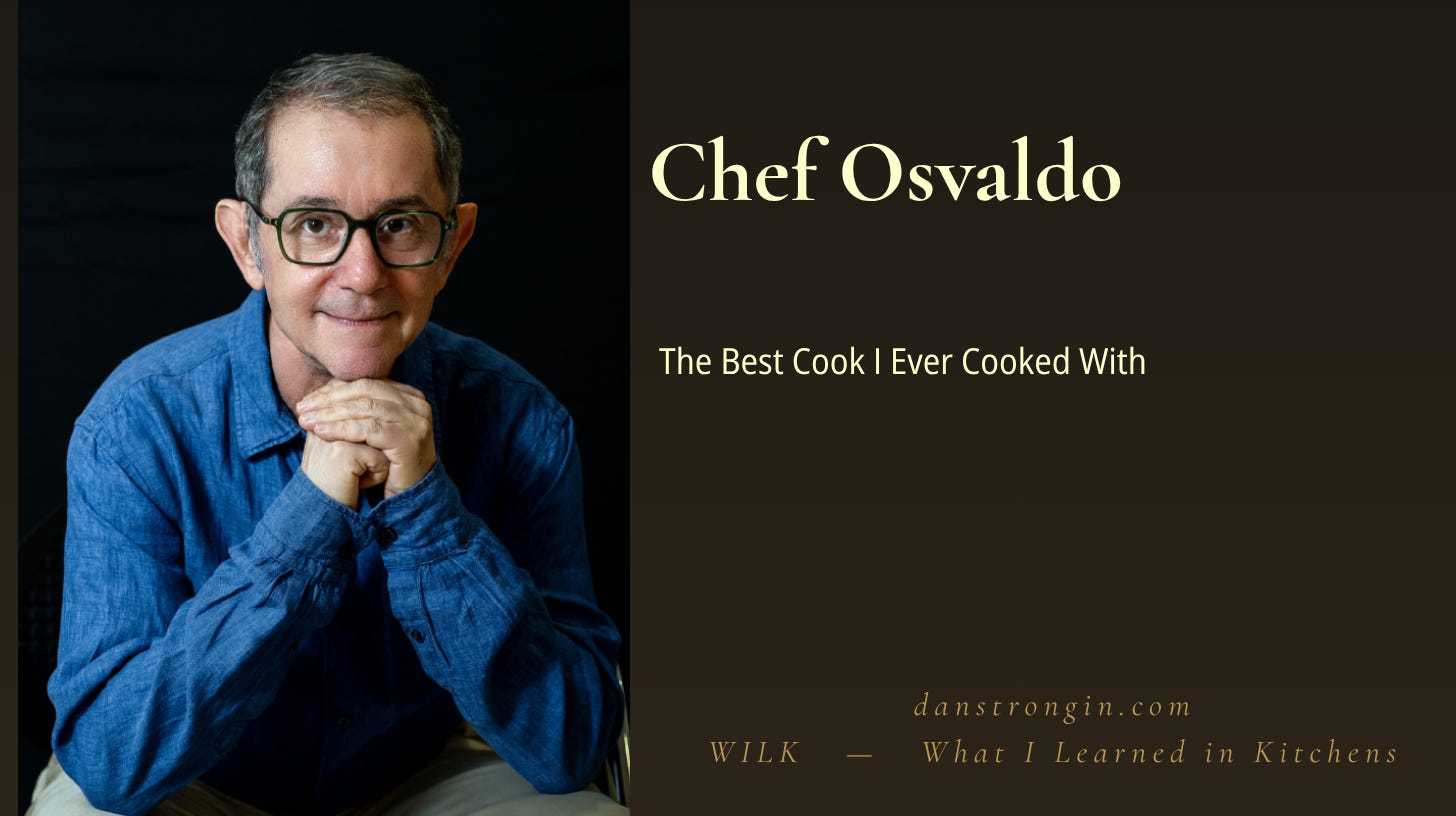
He called himself the Master. He said it with the pleasure of a man who’d earned the right and knew it. “Poor master, he works so hard!” — and then he would smile, turning the hard work of a life into a celebration. Proud, yes, but not in competition. He was self-contained. The confidence came from knowing exactly what he was doing and having done it ten thousand times. It was the kind of pride that doesn’t make you feel small standing next to it.
His name was Osvaldo Rosato. Saucier of the Ritz Carlton Boston — the most important station in a classical kitchen, the first violin — and the best cook I have ever worked with.
I was twenty-two. I’d been put on the vegetable sink my first day, to his right, and worked my way up to entremetier (Vegetable and Fry Cook). My station was right next to his — close enough to watch what cooking looked like when done by a master.
What I noticed first was the station. Not the man — the station. His pots sat in an order only he understood, until you watched long enough to find the logic in it, and then it was the only order there could have been. Everything already where it needed to be.
He moved fast without looking like it. The thing about someone who really knows is that their motion has an economy to it. A sauce pot tilted, tasted, set back down. A pan lifted, a sauce ladled on top of a shimmering silver platter of food, then gone. No searching. No wasted reach.
He thought I looked like Charlie Chaplin, so he called me Charlie. He’d taken a shine to me and wanted to teach me; the nickname was his way of showing it. He’d taken me under his wing.
He was from Abruzzi, and he’d tell you so. He’d also tell you the best cooks in Italy all came from Abruzzi, and you had no reason to argue. He kept a pot of Chicken Cacciatore in the fridge and at the ready in his house at all times, in case someone came by hungry. I know, because I used to show up hungry. The pasta had to be from Abruzzi. This was not a preference. It was a fact of life.
He was a hardworking, capable man, and he carried his whole culture with him. That’s the Italian inheritance — everyone imbued with their history and their art, the opera and the poetry, schooling or no schooling. The knowledge he had was cultural and tacit, the kind a lot of cooks of his generation carried. It came from apprenticeship, and from a life lived the way he lived it. Learned by doing.
His Chrysler was spanking new, and it shined. The seats swiveled out when he opened his door. For him it was a symbol of everything he’d made of his life. Over the years, when he could, he invested in residential buildings around Boston. His nest egg. There was nothing simple about him. He strutted, in his own way, like a rooster. He’d earned it.
He’d started at nine. Apprenticed — no school, no real childhood — to the chef who had once made the stocks and sauces in Escoffier’s own kitchen in Paris. A hard way to come up. But the apprenticeship, and the line it ran back along, had given him something worth as much as anything University could teach.
Escoffier — the King of Chefs, and the Chef of Kings. I’d read about him. But reading about a man and standing next to what he handed down are different things. I was learning from someone whose cooking traced back, through apprenticeship, to the Ritz in Paris in 1900. An unbroken chain of transmission.
Every great Chef I worked for had a mother and grandmother who could cook circles around them. Proud men, and humble at the same time.
When he finished a platter — the food went out on silver, loaded in the kitchen and plated in the dining room — he set it down with a small flourish and said, “Voila.”
Osvaldo was comfortable working. His station was defined by him, and became an expression of who he was. Every dish he made, he made a masterpiece — and not to impress anyone. He wasn’t performing. He was doing it the way it should be done, the way it has been done as long as anyone worthwhile has been doing it. He hadn’t adopted a system. He’d been formed by one.
One day I made a sauce the way I’d watched him make it, then tasted his beside mine. His was so much more refined — deeper, cleaner, delicious in a way mine wasn’t. I asked him: I made this the way you showed me, but yours is so much better. How long does it take to master sauces? He said, “Only a year or two to learn the basics. A decade to master them.”
Another time: “Do it. Pay attention. Study what happens. You’ll master it to the best of your ability by doing it. Cooking will teach you, if you let it.”
When those men retired — Osvaldo, Johnny White at the broiler, Gigi the butcher — the kitchen changed in a way no one could name at the time. The new cooks had been to culinary school. But they hadn’t apprenticed — hadn’t stood shoulder to shoulder with someone who’d stood shoulder to shoulder with someone, back and back. My first chef, Elie Apteker, had laid it out for me once: to become a chef, you apprentice for some years, then spend a decade moving from one kitchen to another under one chef or another, and only then are you ready. Osvaldo was saying the same thing about sauces. Something went out of the room when those men left, and it didn’t come back.
His word for himself was Master. He said it with humor. But it was the right word. Mastery lived inside him, and he carried it forward — passed it on — to keep it alive. I owe him a debt I’m trying to repay by writing this.
Osvaldo´s mastery had roots. Carême built the system, Escoffier refined it into five mother sauces, and Osvaldo had spent a lifetime standing inside that lineage, hands trained on it. In Kitchen Notes, I lay out the system itself: what the Saucier’s station actually holds, why those five mothers still organize sauces made in a classical kitchen today, and why sauce — more than any other station — punishes shortcuts you can’t see until service. If you’ve ever wondered why a good sauce takes days to build and seconds to ruin, this is that answer.
Kitchen Notes is available to paid subscribers.
