Clean as Your Go
I got in the weeds once during service at the Ritz

Pans piled up. Cutting board covered in scraps. Tools scattered. Towels on the floor. I was trying to cook, but I kept having to push things aside to find what I needed. The orders kept coming, and I kept falling further behind.
That’s when I started watching Chef Oswaldo differently.
I’d been watching him cook for months. Watching him taste, adjust, plate. But I hadn’t been watching how he worked.
Before service started, Chef Oswaldo set up his station. Every day, the same way.
Two towels, folded lengthwise in thirds—thick enough when doubled over to grip a hot pan without burning your hand. One tucked into his apron strings on the left, always kept dry. That was for handling pans. The other on the right, for wiping his hands or the cutting board. When a towel got wet or dirty, he’d replace it immediately. A wet towel will burn you—water transfers heat faster than dry cloth. A dirty towel spreads mess.
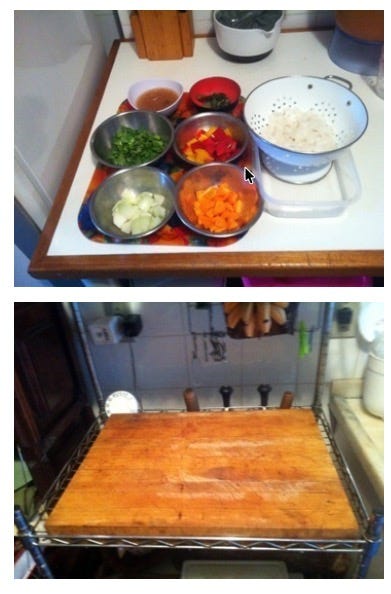
Cutting board front and center. Nothing else on it except what he was actively working with. Bench scraper to the right, within easy reach.
Sauces in small crocks—béchamel, velouté, demi-glace—sitting in the bain-marie, the stainless steel trough filled with hot water that ran the length of the stove. The water kept them warm through the entire service, two and a half hours sometimes. Lids nearby to prevent skin from forming.
Garnishes and seasonings—chopped parsley, chives, shallots, clarified butter, lemon wedges—portioned into small stainless steel inserts, the kind that nest into hotel pans. These sat in an ice bath next to the stove, arranged by what he used most. Parsley closest. Shallots next. Everything cold, everything accessible.
Utensils for the stove—tasting spoons, stirring spoons, long-handled fork—standing in a tall crock filled with water. He’d use a spoon, rinse it in the water, return it to the crock. Always clean, always ready.
Knives laid out to the side of the cutting board. Not in a block—that takes too long during service. Just lined up: chef’s knife, paring knife, boning knife. Steel next to them for touching up edges. Long straight-tined fork at the ready for turning and plating.
Everything had a reason. Everything had a place.
When service started, he moved like a dance. Reach for the pan, plate the food, wipe the board, scrape the scraps, reach again. His board was never cluttered. His towels stayed folded. Nothing piled up.
Small acts. Constant. Rhythmic.
And when he finished a dish—plated it on the silver platter, set it under the heat lamps for pickup—he’d step back and say: “Voila!”
Sometimes he’d add, with a grin: “I am the master! The master is a genius!”
We’d laugh. But he wasn’t wrong.
The rest of us—myself included—worked differently. Pans stacked up. Towels in a heap. Tools wherever they’d last been set down. We were good cooks. Fast, capable. But our stations looked like controlled chaos.
Chef Oswaldo’s station looked like it was waiting for service to start, even in the middle of the rush.
I started copying him.
Not the cooking—I wasn’t ready for that. But the setup. The two towels, folded the same way. The knife arrangement. The bench scraper within reach. I started wiping the board between tasks instead of letting scraps pile up. I started putting tools back instead of setting them down wherever.
It felt slow at first. Like I was wasting time cleaning when I should be cooking.
But then I noticed something.
I stopped looking for things. My hands knew where everything was because everything was always in the same place. I stopped knocking things over. I stopped stepping on towels. The board stayed clear, so I had room to work.
And when I needed to move fast—really fast—I could. Because nothing was in my way.
The clean station wasn’t the goal. It was the condition that made everything else possible.
Satchel Paige, the baseball pitcher, used to say: “Don’t look back. Something may be gaining on you.”
In a kitchen, what’s gaining on you is the mess you didn’t clean. The pans you didn’t wash. The board you didn’t scrape. The towel you didn’t fold.
I still remember watching him near the end of a long service. The other cooks were wiping down, stacking pans, getting ready to break down their stations. Chef Oswaldo’s station looked like it had at the start—organized, clean, ready.
He moved through the last few orders without hurrying. No wasted motion. No clutter. Just the work.
And when he was done, he stepped back, set the final platter under the lights, and said it one more time:
“Voila.”
What Oswaldo had wasn’t a gift. It was a system.
And it translates directly to your kitchen at home — not the professional version scaled down, but the real thing: the two-towel setup, the mise en place habit that changes how cooking feels, and why cleaning between steps — not after — is the single most useful thing you can take from a professional kitchen.
Kitchen Notes has the complete home version: how to set up before you turn on the heat, how to keep the board clear while you cook, and the rhythm that makes cleanup nearly done by the time dinner hits the table.
Kitchen Notes is available to paid subscribers. A paid subscription ensures I can keep on writing these! Thanks!