

That Green
Spectacularly Alone


You hold the asparagus near the tip with one hand and near the bottom with
the other. If your hands are relaxed — no tension, feeling into the stalk —
you can sense its quality through your fingers. Fresh asparagus has a
particular crispness, a kind of aliveness you can feel there. You match that.
You bring your hands to the same degree of delicateness, and then you bend,
and the stalk finds its own breaking point and gives there, cleanly. Not where
you decided. Where the asparagus was ready to give. The only way to find it is
to stop gripping and start listening.
We had bushels of them. Very fresh. You could tell by how they snapped.
The prep table ran along the back wall. I worked facing it. The double sink
was built into the table on my left — used for washing vegetables and pots —
and the working surface ran out to my right, where I had the asparagus. Past
the end of the table, the line continued: steamers, then the big steam-
jacketed kettles, then the bank of stoves running down the length of the
kitchen. Behind the stoves, a plating corridor with heat lamps and shelving
cut off the line of sight to the dining room doors. Behind me, the Bain
Marie — a long water bath, humming at temperature, keeping the sauces ready
through service. I was somewhere in the middle of all of it, working through
the asparagus.
Repetitive work under pressure does something to the mind. The hands take over.
I took the swivel peeler to the lower third of each stalk. Turn the stalk as
you peel. Eighth turn, another pass. Turn. Pass.
A deep, wet green, bleeding up through the peel. Not the pale color of the
skin — something underneath, something the plant had been keeping. It came with
each pass of the peeler, brilliant for a moment. Stalk by stalk, the same
green rising and dimming.
A small ping and scrape with each pass. The blade swiveling on its post, then
drawing down the stalk. The trimmed skins curled and fell. A pile formed to
one side, the peeled stalks to the other, leaning against each other in the
tray. There was a rhythm I didn’t consciously find — it found me. The motion,
the pace, the sound all became music. And then it was just the work, moving
through my hands, and my mind had stepped out somewhere.
That is the particular kind of alone that comes from working inside a task like
that. Not loneliness. The noise of the kitchen went on — orders called, pans
crashing, the hiss of the steamers — and none of it reached me. I was at the
table with the asparagus, and that was the whole world. Small and specific and
enough.
I have peeled asparagus hundreds of times since. The color never stayed in the
stalks. By the time the tray was full, the green I had seen rising at the
peeler’s edge was already gone from the asparagus itself. It only ever existed
in the moment of release.
But it stayed in me. Not as a memory I have to reach for — as something that comes forward on its own, intact, every time. The body holds onto things the mind lets go.
Ratios, temperatures, times — those are in recipes and books. The green that bled up
through the peel is not. Neither is the sound a knife makes when
it’s moving right, or the particular resistance of a good dough. Repetition is
how you put it there. I finished the tray, lined them up. The green was gone.
Someone called a ticket. The kitchen came back.
Fifty years later, I still see it.
--------------------------------------------------------------------------------
The article was about what the body keeps. These notes are about what you can
do, this week, with asparagus on a counter.
Kitchen Notes
Usually for paid subscribers, free for you to get a taste of what paying delivers.
ANATOMY
Asparagus is a shoot — the spear that comes up out of the crown in spring,
before the plant unfolds into the feathery summer fronds you may have seen in
a garden.
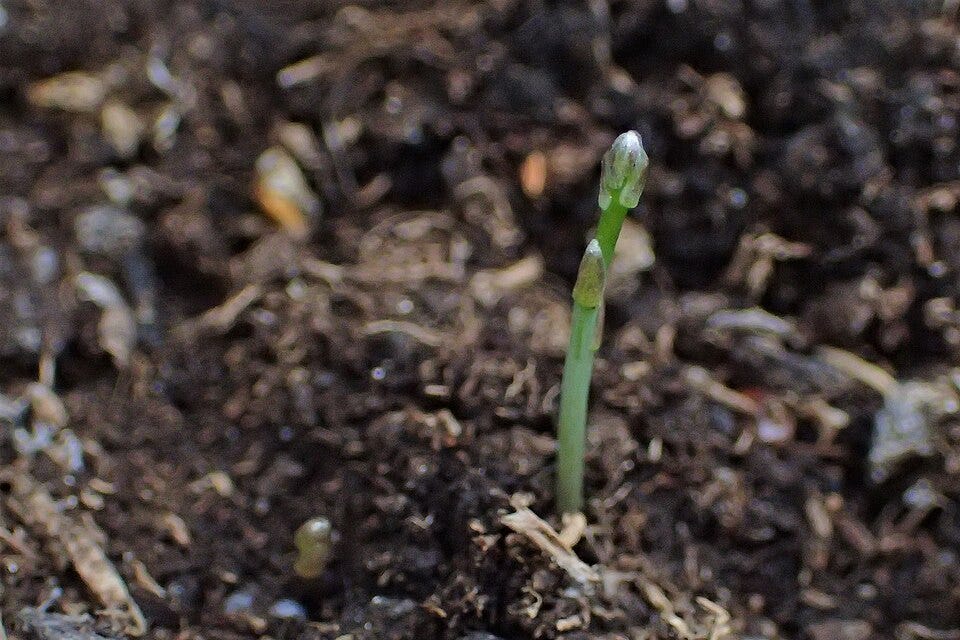
Krzysztof Ziarnek, Kenraiz, CC BY-SA 4.0 <https://creativecommons.org/licenses/by-sa/4.0>, via Wikimedia Commons
The tip is a tight cluster of bracts, the protective scales that
would have opened into branches if the spear had been left to grow. Below the
tip, the stalk is a pole of fibrous tissue that gets tougher as you move down
toward the cut end. The base is woody. The middle is firm. The top half is
tender. That gradient is why a single piece of asparagus can be both perfect
and inedible at the same time, and it is why the lower third needs help.
BUYING
Fresh asparagus stands up. Bend a stalk gently at the store; if it flexes
without protest, it is older than you want. The cut ends should be moist, not
dry or split. The tips should be tight and dry, not flowering, not slimy.
Thickness is preference, not quality — pencil-thin and thumb-thick can both be
excellent. The relevant question is how recently it was cut. If the store
keeps the bunches standing in a shallow pool of water, that is a good sign.
They know.
THE SNAP TEST
Hold the stalk near the tip with one hand and near the cut end with the other.
Relax your hands — this matters; the snap will not tell you the truth if you
are forcing it. Bend slowly. The stalk will break itself, cleanly, somewhere
in the lower third. That break is the line between tender and fibrous. The
cook does not decide where it is. The asparagus does.
You can do this with one stalk to find the break point on the batch, then cut
the rest at that height with a knife. You don’t have to snap every spear.
Once you know where the break wants to happen, you have the information.
PEELING
Take a swivel-blade peeler — the kind that pivots on a central post — to the
lower third of the stalk. You are not stripping it. You are taking only the
outer skin, the fibrous layer that will not soften no matter how long the
asparagus cooks. Below that skin, the same flesh as the tender upper part is
waiting.
Lay the spear flat on the cutting board, tip pointing away from your peeling
hand. Keep it flat — angled, the spear will break. Hold it just above the
middle with your other hand, and run the peeler away from your holding hand,
from a few inches below the tip down toward the cut end. Stay below the tip.
The bracts at the head are fragile, and a careless stroke will shred them.
The asparagus is not forgiving there.
One pass takes a strip. Roll the stalk an eighth of a turn — not a quarter;
the peeler’s contact patch is narrow, and a quarter would skip ground or
double back — and take another pass. Keep rolling and peeling until the skin
is gone all the way around. The whole stalk should now be the same translucent
pale green as the tender section above.
If you are peeling more than a few, you will find the rhythm yourself. The
hands learn it before the mind does.
BLANCHING
Bring a large pot of water to a strong boil first. Salt it lightly. Asparagus
is too tender to rinse, and whatever salt the water carries into the spears
will stay there. The salting still matters — it is the only moment the
asparagus seasons from the inside — but the level needs to be one the vegetable
can carry without help. Heavier salt belongs in the water for tougher
vegetables that can take a rinse, like green beans. Same rule under both: the
salt level meets the vegetable where it is.
Now the adaptation. A standard blanch goes into a hard rolling boil and stays
there. Asparagus cannot. The agitation will break the spears. So you bring the
water to a strong boil to get the heat in reserve, then you ease the heat back
when the asparagus goes in — high enough that the water returns to a boil
quickly, but not so high that it thrashes. Stir gently as the spears go in,
because if the surface of the vegetable seals against still water, gas trapped
inside the cells will damage the color. The stirring keeps that from happening.
Once the water comes back to a boil, count twenty to thirty seconds — and
watch. That is the whole window. Blanching is not cooking. It is not par-
cooking. It is a brief plunge that sets color and barely touches the structure.
The asparagus will come out of the pot short of done; it will finish in butter
or sauce or whatever you reheat it in.
Test by lifting one spear out and biting the cut end. The target is just short
of al dente. Al dente is fully cooked with feel still in the bite — what the
tooth meets when the pasta or the vegetable is right. For blanching, you want
a little less than that. The spear should be cooked enough to have lost its
raw edge, but with a touch of cooking still ahead of it, because the asparagus
will be reheated or dressed later and that second pass will take it the rest
of the way. The exact stopping point is something each cook finds by doing it
a few times. Trust the bite.
THE SHOCK
The instant the asparagus is done, lift it out and plunge it into a bowl of
ice water. This is not optional. Without it, the residual heat in the spears
keeps cooking them after they leave the pot, and you will have soft asparagus
on the plate.
The cold also sets the color. The full chemistry of how green vegetables hold
their color through heat — and how they lose it — is a story that belongs to
the green beans piece. For asparagus, the operative thing is shorter: brief
blanch, light salt, fast shock. Three rules. Hold them and the color holds.
Leave the asparagus in the ice water until it is cold all the way through,
then drain. It is now ready to be reheated quickly in butter, dressed cold,
or finished any way you like.
THE FUGITIVE PART
The article said the green I saw at the peeler’s edge only existed in the
moment of release. That is true and it stays true. Blanching does not bring
that green back. What blanching does is set a different and equally real green
that you can plate and serve. The cook who knows both is paying attention to
what each part of the work actually delivers. The peeler shows you the plant.
The blanch shows you the technique. They are not the same thing.
ON THE KIND OF KNOWLEDGE THIS WORK BUILDS
The article ended on a fifty-year-old memory of color. A reasonable reader
might wonder whether any repetitive task produces this kind of durable sensory
knowledge — whether folding laundry or filing paperwork would do the same.
It does not, and the difference is worth naming. The repetition that builds
the knowledge has three conditions. First, the work has to be done correctly.
Sloppy repetition trains sloppy hands. Second, there has to be real time on
the task — not minutes, hours, day after day. Third, the work has to be under
enough pressure that you cannot half-pay-attention. The pressure is what
quiets the mind and lets the body learn directly.
Most home cooks will not get those three conditions, and that is fine. The
point of the article is not that you should peel a bushel of asparagus to
acquire what fifty years of professional work acquired. The point is that this
kind of knowledge is real, that it lives in the bodies of people who have done
the work, and that the recipes and ratios in books are a small part of what
cooking actually is. When you eat something cooked by someone with that kind
of knowledge in their hands, you can taste it. That is enough.